How Fatoumata Brought the Smiles Back
The children at the displacement site in Sévaré, Mali, were silent when Fatoumata arrived. As a community volunteer trained in psychosocial support, she recognized the silence immediately — the heavy, uneasy quiet of children carrying more than they could express. They perched on the edges of their seats, avoiding one another, unsure whether it was safe to connect.
In Mali's Mopti region, communities have been living through a slow-moving crisis for years. Armed conflict has pushed tens of thousands of people from their homes into displacement sites — adults and children alike arriving in unfamiliar places, carrying losses they haven't found words for yet. For the children, the disruption goes deep: routines gone, schools interrupted, friendships severed. What fills the gap is often silence, withdrawal, and the kind of isolation that, left unaddressed, follows a child for a long time.
Fatoumata sees it every time she arrives at a new group. "Many of these children," she says, "are marked by what they've been through." Her job is to find a way back in.
Why She Showed Up
Fatoumata didn't come to this work by accident. "The desire to provide tangible support to children and families affected by difficult situations — particularly displacement and trauma — motivated me to become a volunteer," she explains.
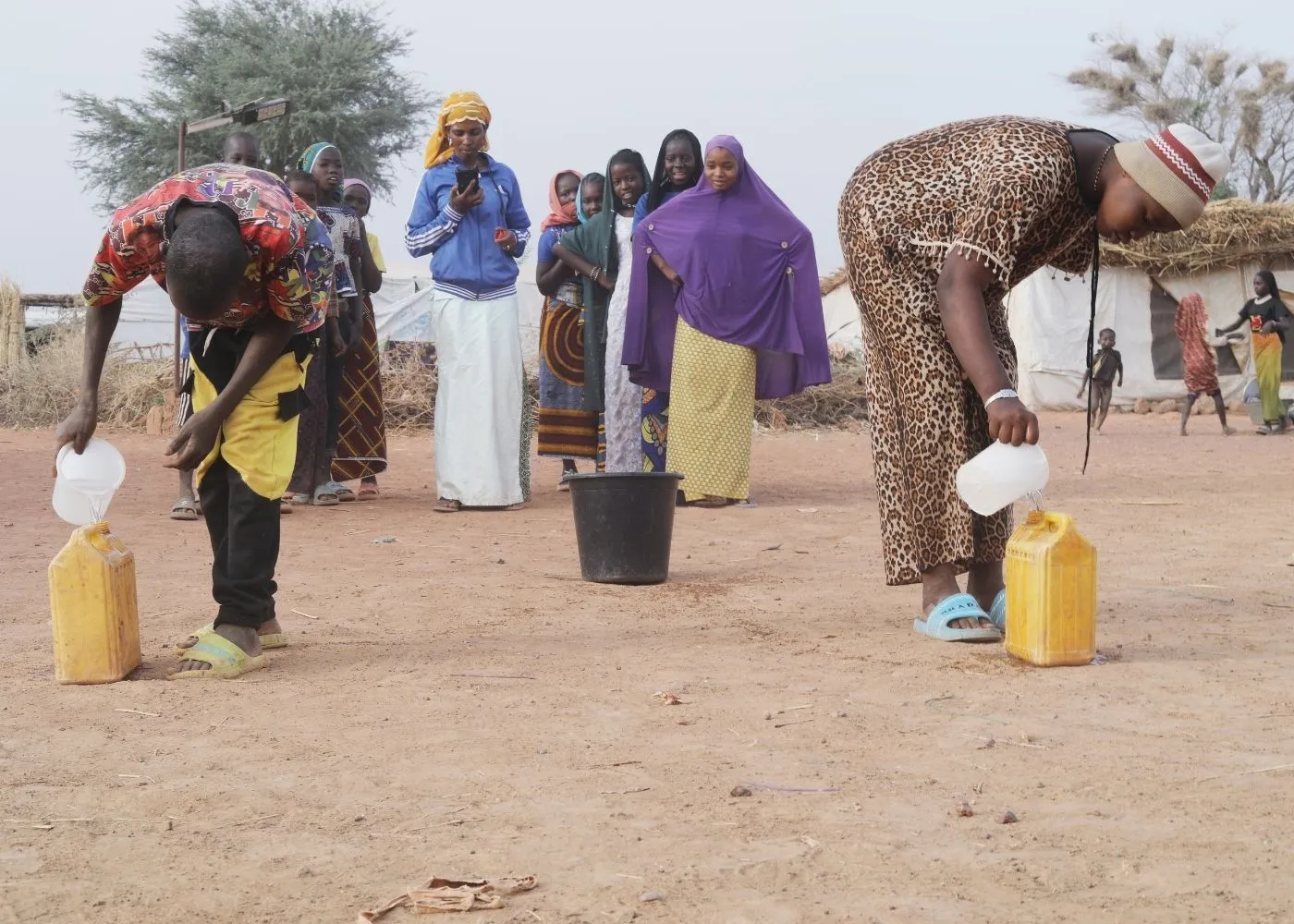
As a community volunteer trained through the EMPOWER project — funded by Global Affairs Canada and implemented by Right To Play — Fatoumata received training in psychosocial support, child protection, and trauma management. The tools she uses are deliberately simple: buckets of water, circle games, songs, movement. Activities that don't require a shared history or a common language of grief. Just a willingness to play.
"As a volunteer," she says, "my role is to play with the children and bring them joy, so they can move beyond what they have experienced and where they come from."
"My role is to play with the children and bring them joy."
EMPOWER works in conflict-affected communities across Mali to ensure that displaced children — many of whom have lost access to school, official documentation, and safe community structures — can re-engage with learning and reclaim a sense of belonging. Fatoumata is one of the volunteers who makes that possible at the most local level: not a programme or a policy, but a person who shows up.
What Play Actually Does
There's a tendency to describe play in displacement contexts as relief — a break from the hard thing, before returning to it. Fatoumata talks about it differently. For her, play is not a pause from recovery. It is recovery.
"The games we play with the children are very important," she says. "They help children find peace and avoid conflict in their communities, bring back their smiles, and bring them together."
Nouhoum, the site manager who oversees a network of seven displacement sites in the area, has watched the shift happen in real time. When families first arrive, he explains, everyone is in their own private emergency. "Displaced people flee conflict in a state of trauma and find themselves in an unfamiliar setting, where both adults and children are affected," he says. "The introduction of play has helped turn the situation around. Now they are all in the same place and play together — whereas before they did not even approach one another."
That movement — from sealed-off to side-by-side — is not incidental. Children who feel safe enough to play together are children who feel safe enough to learn together. Fatoumata's sessions don't just support wellbeing in isolation; they prepare children to participate in the literacy sessions and life-skills activities at temporary learning centres that EMPOWER supports across Mopti.
"Before, they did not even approach one another. Now they play together."
The Work That Continues
Ask Fatoumata what keeps her coming back, and she points to the children. The shy ones who take a few sessions before they join the circle. The ones who arrive carrying something heavy and leave a little lighter.
She is one part of a larger shift EMPOWER is working to make permanent — not just protecting individual children, but changing the conditions in which displaced children live, learn, and grow. The volunteers, the learning centres, the child protection networks: all of it is designed to create communities that hold children, not just catch them when they fall.
In Sévaré, that work continues, one session, one circle, one game at a time.
"The games help children find peace — and bring back their smiles."
The EMPOWER project supports displaced and conflict-affected children in Mali to access safe, inclusive, and quality education through community-based organisations, psychosocial support, child-friendly learning environments, and social behaviour change programming. EMPOWER is supported by the Government of Canada through Global Affairs Canada.